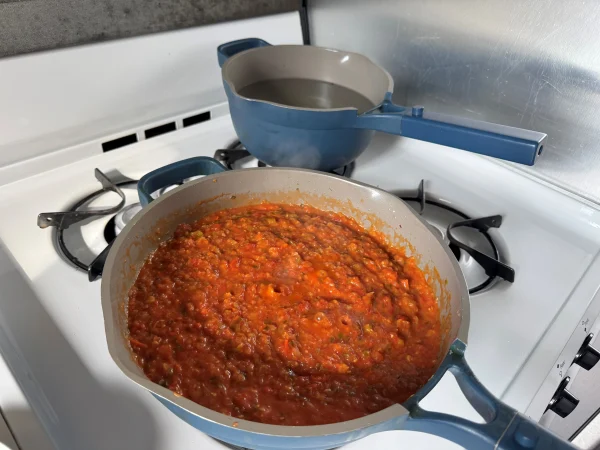







Growing up in an Italian family, we learned to show our love by feeding people. “Here, have another bite” meant I like you. Just filling up an unsuspecting person plate with baked ziti and meatballs meant I really like you, or my favorite is when you have tin pans overflowing with food to go home with meant real love! My Grandmother had an open door policy at her home and always had food on the stove to welcome whoever stopped by. The smell could pull you in from miles away. I don’t remember her anywhere else in her house besides the kitchen, over a large metal sauce pot stirring tomato sauce – yelling at my father to stop eating out of the pot.

I was the lucky one to get my Grandma’s recipe book. It’s a bright yellow photo album with index cards in her writing, falling apart at the seams. It’s truly a piece of history. When I first tried to dive into making one of her legendary meals, I decided to start with one of my childhood favorites, Easter Pie (or Pizza Rustica as she called it). I was confused at first glance. 5lb of flour, 2 dozen eggs . .  who and what was she feeding! As I read down further, the recipe called for a handful of cut prosciutto and the light ham from down the block, 2 baskets of cheese, and a big ball of mozz. To her this was her way of doing one of two things; one: the recipe cards were a quick reminder to her because she made each recipe every year or two: making sure no could every duplicate one of her delicious treats.

After years of taste testing and family gathering, I think we have it pretty close. Nonna’s recipe for Easter Pie!

Nonna's Easter Pie Recipe

Lorem ipsum dolor sit amet, consectetur adipiscing elit. Ut elit tellus, luctus nec ullamcorper mattis, pulvinar dapibus leo.

Ingredients:

For the Dough

  • 6 cups all-purpose flour

  • ¼ teaspoon salt

  • 1 pound chilled salted butter, cut into large pieces

  • 5 large eggs, beaten

For the Filling

  • 1 lb prosciutto, in 1/4-inch dice

  • 1 lb boiled ham, in 1/4-inch dice

  • 1 lb boiled ham, in 1/4-inch dice

  • 8 ounces pepperoni, in 1/4-inch dice

  • 8 ounces soppressata, in 1/4-inch dice

  • 1 lb mozzarella, in 1/4-inch dice

  • 8 ounces provolone, in 1/4-inch dice

  • 2 pounds ricotta

  • 8 ounces grated pecorino Romano

  • 10 large eggs, beaten

  • 1 teaspoon pepper

  • 1 large egg, beaten, for brushing crust

Method:

  1. For the dough: In a large bowl, whisk together 6 cups flour and the salt. Using a pastry cutter, large fork, or two knives, cut the butter into the flour until the mixture resembles coarse crumbs. Add eggs and knead for 1 minute. Add about 1 1/4 cups ice water, a little at a time, to form a cohesive dough. Knead the dough on a lightly floured surface until it forms a large smooth ball, about 5 minutes. Cover with plastic wrap and chill. Let set aside for 30 minutes.

  2. For the filling: Mix the meats, cheeses, the 10 eggs and pepper in a large bowl.

  3. Heat oven to 350 degrees. Divide the dough into two pieces: two-thirds for the bottom crust and one-third for the top. On a lightly floured surface, roll out the larger portion of the dough into a rectangle to line the bottom and sides of a 10 x 15 glass baking dish. Add the filling and smooth it lightly. Brush the edges with a little water. This will act like glue.

  4. Roll out the remaining dough to cover the top of the dish with some overhang. I like to cut a little carrot on the top of the dough while its on the counter, you can just use a fork and poke some holes. Trim off excess dough and crimp the edges to seal. Bake for 45 minutes. Remove from the oven and brush top and edges with the beaten egg, then return to the oven until golden brown, another 45 minutes. Let pie cool completely before serving. 

SAVORY SOURDOUGH PANCAKES

Shared by Suzannah Schneider, Sustainability Connector

I was recently gifted a sourdough starter from a friend. I fed it dutifully, but was dismayed to send the gloopy discards into the trash. I started to save the cast-offs of “unfed” starter, and before long I had enough to make a full stack of sourdough pancakes. This NYTimes-based recipe is tangy and salty, and can be dressed up with maple syrup or stuffed with herbs, seasonings, and greens for dinner. I plan on making a batch of tiny rounds for our next party for a new take on blini.

Ingredients:

For the overnight “sponge:”

  • 1 cup sourdough starter, “unfed”

  • 1 cup buttermilk (make vegan buttermilk by adding 1 tablespoon lemon juice to 1 cup nondairy milk)

  • 1 cup all-purpose flour

  • 1 Tbs light brown sugar

For the batter:

  • 1 large egg or egg replacement (I use 1 Tbs Ground flaxseed whisked with 2.5 Tbs Water)

  • 1/4 cup neutral oil

  • 1/2 tsp vanilla extract (omit if making a savory pancake)

  • 1/2 tsp salt

  • 1 tsp baking soda

  • Optional: chopped dried or fresh herbs, greens, garlic and/or onion, spices…

Method:

  1. Put the sourdough starter in a large bowl and add the buttermilk, flour and sugar, then stir to combine. Cover the bowl and allow it to rest overnight at room temperature.

  2. When you are ready to cook, whisk the egg, melted butter or oil and the vanilla extract together in a small bowl, then add the rested sponge. Add the salt and the baking soda to the batter and mix to combine.

  3. Pour some of the batter onto a preheated greased waffle iron and cook until the waffle is brown and crisp, then repeat. Or use a small ladle to create pancakes on a preheated oiled pan or griddle, flipping them when they are well browned on the bottom. Serve immediately.

Chef Batya from Mae Mae Cafe shared several of her delicious recipes for Mother’s Day.

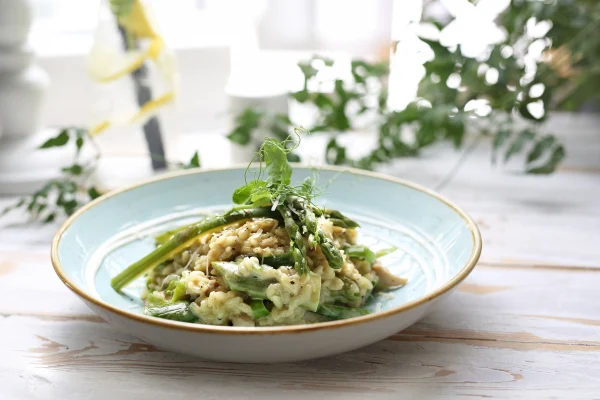
Originally called our Asparagus Cashew Soup, it’s more aptly name as a Vegan Cream of Asparagus Soup. Pureed cashews stand in as cream, offering a rich, creamy flavor without dairy. The comes together in less than 30 minutes and can be eaten as a starter or as a main dish when paired with one of her other Mother’s Day recipes.

Note that raw cashews found in the grocery store have typically been steamed, which destroys the toxins that naturally occur in cashews.

VEGAN CREAM OF ASPARAGUS SOUP

Serves:4

Ingredients:

  • 1 onion, chopped

  • 5 cloves garlic, minced

  • 2 tablespoons olive oil

  • 2 pounds asparagus, trimmed and chopped

  • 4 1/2 cups vegetable broth

  • 1 cup raw cashews

  • ¾ cup water

  • ¼ teaspoon sage

  • ½ teaspoon salt

  • ¼ teaspoon black pepper

  • 2 teaspoons lemon juice

Procedure:

  1. In a large soup pot, sauté onion and garlic in olive oil for 2–3 minutes until onion is soft. Reduce heat and add asparagus and vegetable broth.

  2. Bring to a simmer, cover, and cook for 20 minutes. Cool slightly, then purée in a blender, working in batches as needed until almost smooth. Return the pot over low heat.

  3. Purée cashews and water together until smooth and add to soup. Add sage, salt, and pepper and heat for a few more minutes, stirring to combine.

  4. Stir in lemon juice, and adjust seasonings to taste.

Celebrate the season with some of our favorite timeless recipes!

LYONNAISE BEETS

Serves 4

Ingredients:

  • 2 pounds medium size red beets

  • Salt and freshly ground white pepper

  • ¼ cup olive oil

  • 4 onions, thinly sliced

  • 2 tablespoons chopped garlic

  • 1/2 cup butter

  • 1 tablespoon finely minced fresh parsley

Method:

  1. Preheat the oven to 400 degrees. Wash, trim and dry the beets. Drizzle the beets with a bit of the olive oil, season with pinches of salt and a few grindings of pepper, then wrap them tightly in heavy duty aluminum foil.

  2. Place the wrapped beets on a cookie sheet and roast until tender when tested with a cake tester or sharp knife, 45 minutes to one hour. Take care not to overcook the beets at this stage, as they will be baked again in the final step. Do not turn off the oven.

  3. While the beets are roasting, heat a large cast-iron or other ovenproof skillet over medium-high heat. Pour in the remaining olive oil; add the onions and sauté them slowly until they are lightly colored, eight to 10 minutes. Stir in the garlic and continue until the onions are deep brown, but not nearly burned, and the garlic is soft. Transfer the onions to a bowl.

  4. When the beets are ready, carefully open the foil to allow the steam to escape. When the beets are cool enough to handle, remove the skins, and slice them one-quarter inch thick.

  5. Return the skillet to the stove over low heat. Add the butter; when it is melted, layer the pan with one-third of the beets and season with salt and pepper. Cover the beets with half the onions, cover the onions with another third of the beets, spread the remaining onions over and finish with a final layer of beets, seasoned with salt and pepper.

  6. Place the pan in the oven and bake for 10 to 12 minutes, or until beets are browned on top. Remove from the oven and use a spatula to carefully transfer beets—they should hold together in a disk, but never mind if they don’t; you can push everything together on your serving platter. Sprinkle with chopped parsley and serve.

Celebrate the season with some of our favorite timeless recipes!


Lyonnaise Beets

From Sylvia’s Table

Serves 4

Ingredients:

  • 2 pounds medium size red beets

  • Salt and freshly ground white pepper

  • ¼ cup olive oil

  • 4 onions, thinly sliced

  • 2 tablespoons chopped garlic

  • 1/2 cup butter

  • 1 tablespoon finely minced fresh parsley

Method:

  1. Preheat the oven to 400 degrees. Wash, trim and dry the beets. Drizzle the beets with a bit of the olive oil, season with pinches of salt and a few grindings of pepper, then wrap them tightly in heavy duty aluminum foil.

  2. Place the wrapped beets on a cookie sheet and roast until tender when tested with a cake tester or sharp knife, 45 minutes to one hour. Take care not to overcook the beets at this stage, as they will be baked again in the final step. Do not turn off the oven.

  3. While the beets are roasting, heat a large cast-iron or other ovenproof skillet over medium-high heat. Pour in the remaining olive oil; add the onions and sauté them slowly until they are lightly colored, eight to 10 minutes. Stir in the garlic and continue until the onions are deep brown, but not nearly burned, and the garlic is soft. Transfer the onions to a bowl.

  4. When the beets are ready, carefully open the foil to allow the steam to escape. When the beets are cool enough to handle, remove the skins, and slice them one-quarter inch thick.

  5. Return the skillet to the stove over low heat. Add the butter; when it is melted, layer the pan with one-third of the beets and season with salt and pepper. Cover the beets with half the onions, cover the onions with another third of the beets, spread the remaining onions over and finish with a final layer of beets, seasoned with salt and pepper.

  6. Place the pan in the oven and bake for 10 to 12 minutes, or until beets are browned on top. Remove from the oven and use a spatula to carefully transfer beets—they should hold together in a disk, but never mind if they don’t; you can push everything together on your serving platter. Sprinkle with chopped parsley and serve.

Celebrate the season with some of our favorite timeless recipes!

Spring Radish Salad with Asparagus and Blood Oranges

Serves 4

Ingredients:

  • 1 bunch Easter Egg or other radishes

  • 1 tablespoon lemon juice

  • 1/2 cup plus 2 tablespoons olive oil

  • 12 slender green asparagus spears

  • 2 blood oranges, peeled and pith removed, cut intowedges

  • 1 cup “micro” or smallest arugula available

  • 1/2 cup raw pistachios

  • 3 tablespoons blood orange juice

  • 1 teaspoon Champagne or white wine vinegar

  • 1 teaspoon minced shallots

Method: 

  1. Preheat the oven to 350 degrees.

  2. Wash and trim the radishes, cutting off the tail end and leaves, but retaining a little of the green tops. Cut each radish into four wedges and set aside.

  3. Whisk together the lemon juice and one tablespoon of the oil.

  4. Pour about a quart of water into a skillet or shallow pan and bring to a boil. Trim the ends of the asparagus and peel the lower half. Add a big pinch of salt to the boiling water, reduce the heat and add the asparagus. Blanch the asparagus for about three minutes, then drain and quickly plunge the stalks into a bowl of ice water to stop the cooking. Drain and set the asparagus aside.

  5. Meanwhile, spread the pistachios onto a baking sheet and toast them in the oven for 4 minutes.

  6. Combine the radishes, oranges and pistachios in a bowl and toss with the oil and lemon juice; season with salt and pepper.

  7. Whisk together the blood orange juice, vinegar, shallots and a pinch of salt; slowly whisk in the remaining olive oil and season to taste with pepper and additional salt as needed. Gently toss the asparagus with this dressing and divide them among four plates. Spoon the radish mixture over the asparagus and top with the arugula. The salad also can be arranged on a platter and served at the table.

This month I am so excited to invite our Director of Catering, Mike Warren, to interview the incredibly talented and fabulous Baz Luhrmann, who directed this season’s blockbuster hit The Great Gatsby. Mike worked tirelessly for weeks to create the speakeasy after-party with Warner Brothers and Samantha Sackler Productions, which took place in the gilded, turn of the century, Grand Ballroom. Read further to find out about Baz’s socks.

1) Where were you born?
Sydney, Australia

2) Where do you get your inspiration from?
I get it from the desire to live an adventurous life.

3) What made you want to direct The Great Gatsby?
I heard it on the train going through Siberia as an audiobook ten years ago and realized there was a different film version to be made.

4) Was Leonardo DiCaprio always your number one choice for Jay Gatsby?
Always. There was no list.

5) Why do you think F. Scott and Zelda loved the Plaza?
What’s not to love?

6) Why do you love the Plaza?
Because of its history. It is glamorous, yes, but just a bit of outrage as well.

7) Tell us what you loved about the post-party bash in the Ballroom?
Those things nearly never work. And people hardly ever have a good time. But when Florence and Jay-Z are dancing together you know something is right.

8) What do you do for fun when you are not working?
I am never not working so I try and find fun when I am working.

9) Why don’t you wear socks?
Because I’ve got the ankles for it.

10) If you could have dinner with three people tonight, who would they be?
Catherine Martin, Lillian Luhrmann, William Luhrmann

11) What is your favorite place to travel to?
Asia. With Russia a close second.

12) If you come back in another life, who do you want to be?
Myself, with hindsight and wisdom.

Rob Arango

The man most responsible for causing us to examine what we put onto our plates and into our mouths with his blockbuster Omnivore’s Dilemma is at it again, this time with a book titled Cooked. My copy arrived last week. I love how he once again uncovers fundamental truths that have somehow gotten lost in our postmodern shuffle — hidden-in-plain-sight, simple, logical truths. Just as he peeled back the layers on processed food and industrial farming, this time he engages in the ancient, timeless, and indispensable ritual of cooking.

It is almost ironic that the most eloquent spokesman for the food policy movement was not as he might be imagined — skilled in the kitchen, whipping up all sorts of healthful and delicious meals with confidence — and more significantly — with passion. Not the case, Pollan honestly states in the powerful opening to this new book: “the mildness of my interest in cooking surprises me since my interest in every other link of the food chain had been so keen” (p. 2). Pollan discovers the magic of the cooking process on a personal level but clearly connects it to his search; “….for years I had been trying to determine… what is the most important thing an ordinary person can do to help reform the American food system, to make it healthier and more sustainable?” (p. 1). In this book, Pollan states that cooking is “one of the most interesting and worthwhile things we humans do,” transforming our lives (p. 11). “I learned far more than I ever expected to about the nature of work, the meaning of health, about tradition and ritual self-reliance and community, the rhythms of everyday life, and the supreme satisfaction of producing something I previously could only have imagined consuming…” (p. 12).

In 2006 we established The Sylvia Center for the purpose of connecting a young and vulnerable population of children to a lifeline that could potentially help shape their lives for the better. We would teach them about cooking delicious, healthy food — in season when possible — in a fun and socially engaging environment. A brainstorming session early on created the mission tagline: “Inspiring children to eat well.” Obesity and other diet-related diseases were on our mind, but we knew that to make a change, we would have to involve our young students in a positive and socially engaging program.

We started at Katchkie Farm, where The Sylvia Center team carved out a one-acre children’s garden in the heart of the farm. As children arrived at the farm, they would explore the wide, rainbow-shaped kid-friendly rows, nibbling greens, flowers, weeds, and veggies they never imagined existed. They would plant and harvest before moving to the next activity — chopping together and preparing a meal they would share as a community at the picnic tables adorned with field flowers.

Did we know for sure that if we connected these young eaters to food in a new and slightly radical way, that they might start to think differently about what they were eating? Yes and no — but we believed that on that day, as they experienced a farm along with some vegetables for the first time, that we were “planting seeds.”

And as the program expanded to NYC and we started working in various community centers within the New York City Housing Authority, the effect was equally powerful. There is unexpected joy in being able to transform a raw food product into something delicious. Cooking is a critical skill that grows with time and provides the ability to care for oneself or a family. It is independence from poor food choices and from the world of absolutely unhealthy processed food. It is a connection to great flavors and bridges the disconnect from remote celebrity chefs by making it real and attainable.

So, here we are, working for over seven years with the clear belief that our culinary-based program would positively influence food choices and health outcomes. As funders and potential donors looked at our work, their requests for metrics that connect the work to our stated outcome were amplified. The analysis is happening as we speak.

This is where Michael Pollan steps in. As Michelle Obama did with her White House Garden and Let’s Move campaign, sometimes it takes someone of great stature to galvanize support for something that is in fact not complicated and even obvious. Plant a garden, engage in physical activity — see how things can change. Cook a meal with children — offer them wonderful fresh foods — and see if they don’t respond positively, refilling their plates.

Back to Michael Pollan — “The shared meal is no small thing. It is a foundation of family life, the place where our children learn the art of conversation and acquire the habits of civilization” (p. 8 of Cooked). As a culture, we have lost our way to the kitchen, distracted by hard days at work, and seduced by the myriad of options from fast food to alluring restaurants and easy frozen or prepared supermarket options. But when we find the joy, taste, and beauty of cooking in the kitchen, something wonderful happens.

Thank you, Michael, for “Pollan-ating” our program. We take this as an affirmation that we are on the right path and are thrilled that we share the joy and benefits of cooking with you.

See you in the kitchen!

-Liz Neumark

I love food — being around it, cooking and eating it, sharing and learning about it — and most meaningfully, making sure that the bounty and access I have is also available to others.

I was at the National Food Policy Conference, sponsored by the Consumer Federation of America, in DC last week. Attendees included individuals from government agencies, the food industry, academia, public interest organizations, various nonprofits, nutritionists, activists, PR companies — all interested in key food policy issues. As we sat for two days, listening to speakers and panelists on controversial topics facing consumers, manufacturers, producers, and government, the urgency and complexity of food policy issues multiplied, exacerbated by a fiscal crisis, political inertia, and special interest lobbying. There is a lot to think about, there is a lot to worry about and there is so much to do.

Over the past several months, I have attended a handful of food policy events, from TedxManhattan‘s “Changing the Way We Eat” to Just Food‘s “Eat-Work-Grow the Movement” Conference to the Laurie M. Tisch Center for Food, Education & Policy’s “Bringing Policy to the Table: New Food Strategies for a Healthier Society.” And there are more gatherings and conversations weekly across a wide range of institutions and organizations across the country, too numerous to list. With each conversation, I learn more and go deeper into topics I am already familiar with. Here are the top hot topics from my perspective, inspired by the DC conference and on agendas everywhere.

1. How safe is our food? How does the FDA monitor domestic food products (as well as what comes into the U.S. food system from other countries?) What about the additives food companies use in processed food under the GRAS provision (Generally Recognized As Safe) since 1958 — a provision intended for common food ingredients, now used to categorize close to 10,000 food additives, 3,000 of which have not been tested by the FDA’s own admission. Tom Neltner, the director of the Food Additives Project in The Pew Health Group at The Pew Charitable Trusts, shared research on testing guidelines. Another concern is the labeling of genetically modified organisms (GMOs) in our food; in the U.S., food companies are not required to list GMO or genetically engineered (GE) foods. Along these same lines, the use of antibiotics in the animals we eat is a growing concern. Other critical issues around animal welfare standards continue to emerge and challenge our system where meat is artificially cheap, the externalized cost borne via environmental and health bills we all pay. Individual state-level laws that prohibit (and in fact criminalize) undercover reporting of factory farming of animals — the “Ag Gag” — are troubling, to say the least.

2. Food Waste — NRDC released figures estimating food waste to be 30-40 percent of what travels from farm to fork through the U.S. food system. The EPA estimates this to be over 65 billion pounds of food a year, a large portion from household waste. The implications of this figure range from tangible quantities of food which could be used to fight hunger; the impact of wasted food production and our limited natural resources as agriculture and food production can be extremely energy and water-intensive; and food waste is a major component of our landfills. Food waste could be diverted into productive use through composting. The UN has launched an anti-food waste initiative, thinkeatsave.org, underscoring the global importance of immediate action.

3. Hunger and Food Insecurity — according to the USDA, in 2012, 1 in 4 Americans participated in a government food or nutrition assistance program. Their research shows that 68 percent of food-insecure families contain at least one full-time working adult. Most food stamp/SNAP beneficiaries are children, seniors, working parents, and people with disabilities. A signature of our times, the prevalence of hunger with obesity, is in part the result of lack of access to healthy foods in many low-income communities and the predominance of cheap, unhealthy calories. Other contributing factors, such as lifestyle, unemployment, and healthcare, are part of a complex web of social conditions, with food being a key component. It must be unacceptable to all of us that in the richest country in the history of the world, families strategically plan for days when family members will not eat because they have no food.

4. Immigration Reform — how the lack of policy affects agricultural workers and farmers with a cascade of issues from decent working conditions and fair wages for migrant and undocumented farmworkers to the ability of farmers to hire steady and authorized workers. In the U.S., we underestimate how important the immigrant contribution is to our food system.

5. Farm Bill legislation — from subsidies to the largest growers to the impact on key nutrition program funding, the Farm Bill touches vast swaths of American lives in ways most of us don’t know. Polls show that many Americans favor reducing subsidy payments to the largest farmers, and at the same time want to continue to pay for programs funding local as well as international anti-hunger relief efforts. Congress did not succeed in passing a new farm bill in 2012 and extended the 2008 bill for nine months.

6. Impact of climate change on our food supply — the extreme weather patterns affecting farm communities, from droughts, flooding, temperature extremes, and other uncontrollable conditions. Every conversation about agriculture now includes provisions for thinking about an altered landscape.

7. The impact of reduced resources on regulation, legislation, and change — what does the current economic climate hold for food policy issues? Think about this — the poultry industry has grown four-fold since the Reagan era, yet the inspection budget has not. Looking ahead, the poultry industry will potentially self-regulate. Currently, government inspectors look at 140 birds/minute. Under proposed changes, poultry industry inspectors will look at 175/minute, leaving 1/3 of a second for each bird to be inspected. This will save the government about $90 million over 3 years. Self-regulating industry — what an optimistic concept.

This is a partial list — a mini “menu” of the myriad of issues categorized as the food policy agenda. I return to my day job as CEO of Great Performances, where we feed the most privileged New Yorkers daily, with new determination to make every meal we cook help fuel an agenda that demands accountability for what is in the food we serve and who is missing at the table.

Liz Neumark


Spring Radish Salad

Ingredients:
  • 1 bunch easter egg radishes
  • 2  blood oranges
  • ½ cup pistachios
  • 1 tsp. lemon juice
  • 1 Tbsp. olive oil
  • salt and pepper to taste
  • 12 asparagus spears
  • 1 cup Katchkie Farm micro arugula
  • blood orange vinaigrette, see recipe
Instructions:
  1. Wash and trim the tops of the radishes so that some of the green is left.  Cut each radish into four wedges and reserve.
  2. Peel the oranges, being careful to remove all of the pith, then separate the segments. Set aside and keep the orange remnants to use for the vinaigrette.
  3. Toast the pistachios in a dry skillet over medium heat. Remove and set aside to cool.
  4. Place the radishes, oranges, and pistachio in a large bowl, then add the lemon juice, olive oil, salt, and pepper.
  5. Toss together and adjust the seasoning if you desire.
  6. Peel the asparagus and blanch in salted boiling water then shock in ice water, drain, and reserve.
  7. Prepare the Blood Orange Vinaigrette (see recipe below) and toss a bit of the vinaigrette with the Asparagus.
Blood Orange Vinaigrette:
  • 3 Tbsp. blood orange juice
  • 1 tsp. champagne vinegar
  • 1 tsp. minced shallot
  • salt and pepper to taste
  • 9 Tbsp. olive oil

Whisk together the blood orange juice, champagne vinegar, minced shallot, salt, and pepper. Add the olive oil while continuing to whisk. Taste and adjust seasoning if necessary.

Plating:

Place four asparagus on a plate.  Spoon the radish mixture on top.  Place some micro arugula on top and drizzle with vinaigrette for a very refreshing spring radish salad.

Asparagus and Onion Frittata

We love frittatas at any time of day.

Ingredients:
  • 1/2 lb asparagus
  • 4 oz baby portobello mushrooms, sliced
  • 2 garlic cloves, pressed
  • 1 T olive oil
  • 6 eggs
  • 1 T milk
  • 1 T fresh tarragon, chopped
  • 1/2 c parmesan cheese, finely shredded
  • 1 T butter
  • 1 pinch salt and pepper
Instructions:
  1. Steam asparagus until just tender
  2. Heat olive oil in a pan over med/high heat.
  3. Add garlic and saute till fragrant
  4. Add mushrooms and continue to saute until mushrooms soften.
  5. Combine eggs and milk, salt, pepper, and tarragon in a bowl and whisk well
  6. Add cheese and whisk till blended.
  7. Melt butter on low/med heat in a large pan.
  8. Add egg mixture. Stirring constantly until bottom begins to just set.
  9. Spread asparagus and mushrooms onto the egg.
  10. Place pan into a 350-degree oven and cook until eggs are firm to the touch.
  11. Remove pan from oven and invert frittata onto a serving platter
  12. Slice into 8 servings and serve immediately.