For Chef Hervé Knecht, Bouchées à la Reine (Vol-au-Vent) with Spaetzle is a dish rooted in memory.
Growing up in Alsace, it was something served at his grandparents’ table—family-style, with everything laid out in the center and everyone helping themselves. A classic that’s both simple and adaptable, it’s a dish that moves easily between home kitchens and restaurant menus.
We spoke with Hervé about the origins of the dish, how he serves it, and why it continues to resonate.
GP: When is this dish most commonly enjoyed?
Hervé: When I read the question about my roots, this is the dish I picked.
When I was a kid in France, this is something you’d have at your grandparents’ house. A lot of the time, they would make it big family style. They’d put all the pieces in the middle of the table, all the side dishes, and everyone would serve themselves. For me, it’s more like Sunday family style with your grandma and grandpa. For Americans, this is basically like a chicken pot pie. It’s kind of the same idea.
GP: How do you like to serve it?
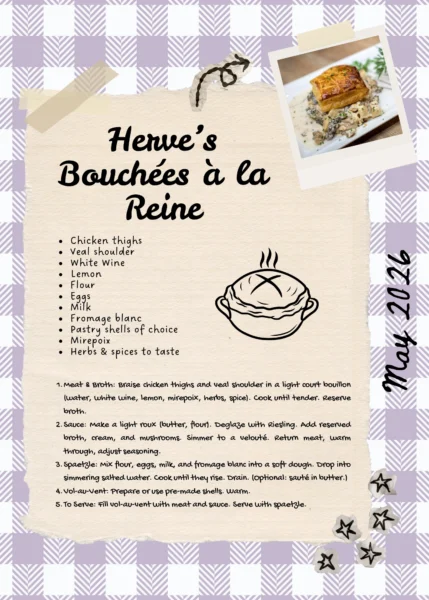
Hervé: Usually I put the vol-au-vent on the plate with everything inside. Then on the side, in a small casserole, we have some extra meat and sauce, because people like this very runny—especially if you eat it with rice or with the type of pasta where I come from. In Alsace, near the border of Germany, we make a type of pasta called spaetzle. This is very typical, a traditional dish from that area.
GP: How does the dish change depending on how it’s made?
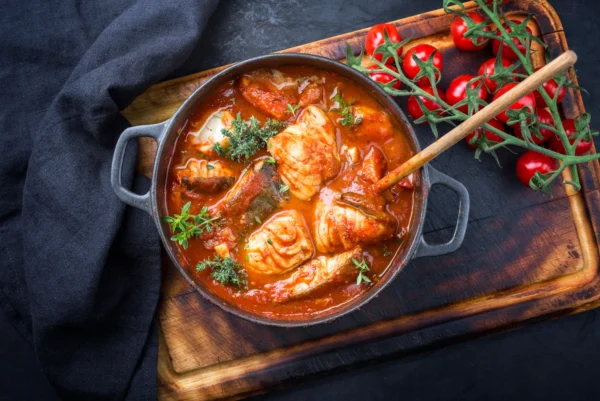
Hervé: It has something very classic and basic, but a lot of high-end restaurants use this. People at home will do it with chicken because of the cost. In a high-end kitchen, you’d do this with veal, sweetbread, or seafood—like lobster—to make it more elaborate. It all depends. People at home won’t go buy a lobster to make this, but everyone can use what they like. When I was a kid, we did a combination of lobster and sweetbread. That goes very well together.
GP: What memories do you associate with this dish?
Hervé: They’re all gone now. No more grandma, no more grandpa. I left home over 25 years ago. When I was a kid, my parents were very busy with their business, so they sent me to a school where you stay during the week and come back on the weekend. On Friday, when you come back home, you want to see your parents, your grandma, your grandpa. So we’d have this, or another type of stew. My grandma always baked a pie for me that I liked. It was good sharing with family.
GP: Why did you choose this dish?
Hervé: Because of the questions you asked, I thought about a different recipe at first. But then I thought about the function of the dish—if it goes to a party. Some recipes that I really like would not work for a party. I really like coq au vin, but it’s too basic. Everyone does coq au vin. I’ve only worked for you for three months, so I tried to think of things that would work for events.
GP: What should people keep in mind when making it?
Hervé: The advantage is it’s something basic and simple to make, but it can go from very classic to more elaborate. Everyone can use the same base and add better ingredients—like sweetbread, veal, or better quality meat than just chicken. Or if they are seafood lovers, they can use lobster.
GP: Can you share a bit about your path as a chef?
Hervé: I lived in the Caribbean for eight years and came to the U.S. as a private chef for a family. I then worked for some restaurants and was working in the Village on Bleeker Street when 9/11 happened. I didn’t feel safe afterwards, so moved back to Europ where I opened a restaurant in Barcelona. I was there for six or seven years, but I missed the New York energy. So I came back and opened a restaurant on First Avenue and 83rd. The culture of owning a place in America and in Europe is totally different. Here, you pay rent—$20,000, $30,000—and it doesn’t work the same. In Europe, you own the place. So after eight years, I sold it. With the money, I did one of the best things—I bought a house upstate.
GP: How did you come to Great Performances.
Hervé: I worked for Blue Ribbon before the pandemic. I was taking care of three restaurants—around 2,000 covers every day. After all those years, I burned out supervising three restaurants. I took a break all summer. Then in September I was looking for a job. My friends in France told me to look at catering. That’s how I found Great Performances. Mike Deuel responded to me and asked if I was burned out at restaurants, and I said yes. It’s still a challenge, understanding how this works. These past three months, I’ve learned a lot of different things.